


No player ever has—and probably no player ever will—generate the kind of hype LeBron James did before playing a single professional game.
Not Michael Jordan. Not Zion Williamson years later.
Plenty of prospects have been labelled “the next LeBron,” but nothing has matched what those of us around the NBA—and far beyond it—witnessed in 2003.
Heading into the draft lottery, the Cleveland Cavaliers and Denver Nuggets each had a 22.5 percent chance of landing the first pick, with Toronto and Miami next in line. Every one of those teams, along with several others holding far longer odds, hoped the lottery balls would fall their way and that LeBron would walk onto the stage wearing their cap before shaking hands with then-commissioner David Stern.
Luck chose the Cavaliers.
Cleveland is less than an hour’s drive from James’ hometown of Akron and St. Vincent–St. Mary High School, where he had attracted an unprecedented level of national attention. The second pick somehow ended up with the Detroit Pistons, who had acquired it through a long-forgotten piece of business: in 1997, Detroit sent Otis Thorpe to the Vancouver Grizzlies in exchange for a protected future first-round pick. By 2003, the Grizzlies had relocated to Memphis and held the sixth-best lottery odds.
Perhaps Detroit would have been better off if the pick had never conveyed. Because, well—Darko Miličić.
Led by Ricky Davis and Zydrunas Ilgauskas, the Cavaliers had stumbled to a 17–65 record in 2002–03, helped along by some fairly shameless tanking. Their average Elo rating for the season was 1,308, down 73 points from the year before. At one stage they fell to 1,226—just 11 points above the lowest rating in franchise history, recorded in April 1982. They closed the season at 1,273, narrowly ahead of Denver, which finished last at 1,258.
Honestly, whether they’d landed LeBron, Carmelo Anthony, Dwyane Wade or almost anyone else from one of the greatest draft classes ever assembled, the Cavaliers were heading for a rebuild regardless. The previous season they’d waived Tyrone Hill and Nick Anderson, the two most expensive contracts on the roster, and within James’s first few months, Ricky Davis and Darius Miles—both starters in the pre-LeBron era—were gone as well.
The 17-win total wasn’t a fair reflection of Cleveland’s actual talent, tanking being what it was, but the turnaround in James’s rookie year was still dramatic: the Cavaliers more than doubled their win total, finishing 35–47. It would be the last losing season Cleveland had with LeBron on the roster. That same year, their Elo climbed back above the 1,500 benchmark for the first time since December 2000.
The following season the Cavs went 42–40—the same record as the New Jersey Nets—and still missed the playoffs, losing the tiebreaker to New Jersey for the final Eastern Conference seed.
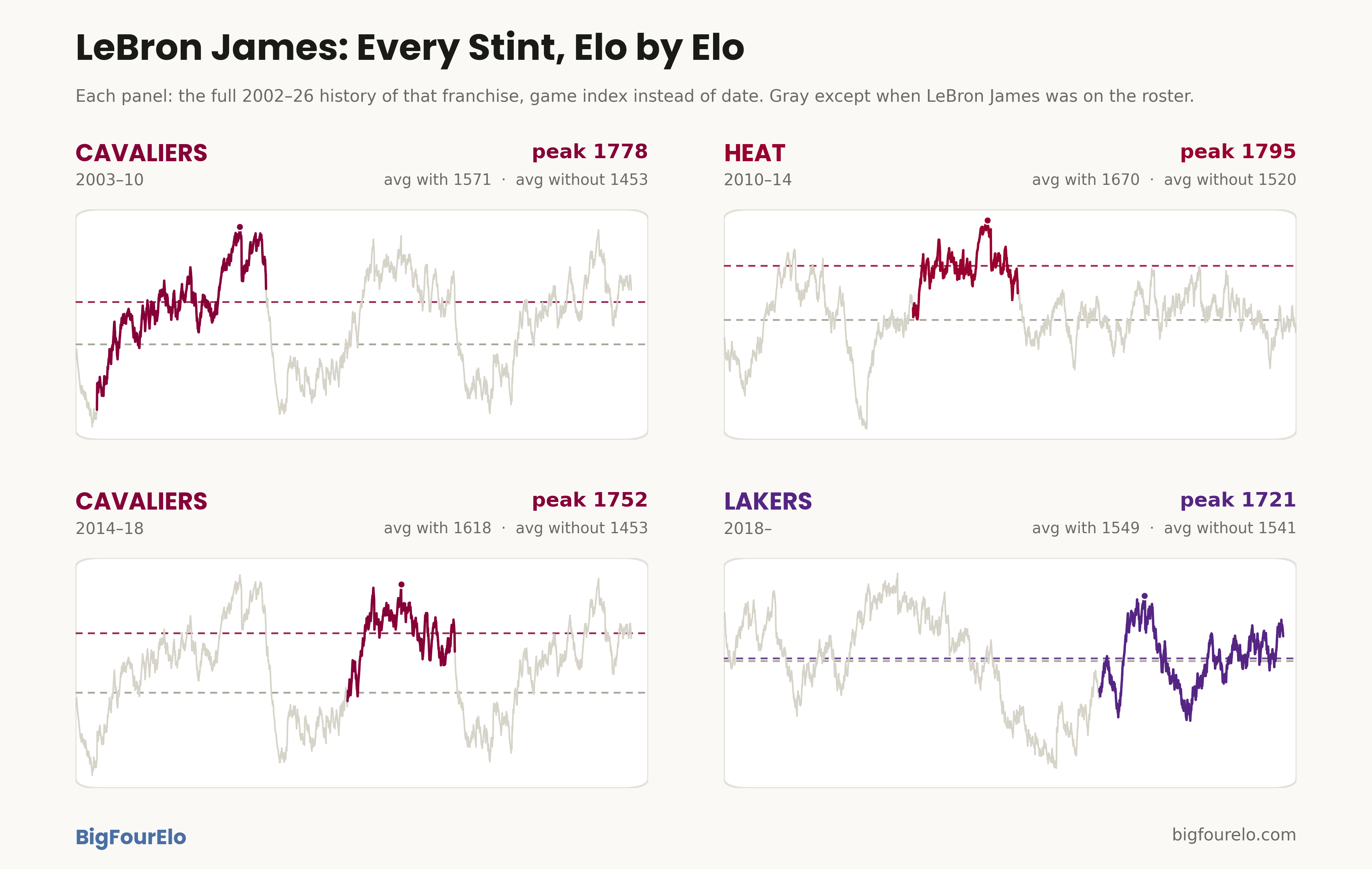
James’s first spell in Cleveland included one trip to the Finals, where the Cavaliers were swept by the San Antonio Spurs in 2007. It also included the remarkable 2008–09 season, when Cleveland won a league-best 66 games and, on May 11, 2009, reached an Elo of 1,778—still the franchise record. They nevertheless lost to Orlando in the Eastern Conference Finals, denying us what might have been our closest chance of ever seeing LeBron James face Kobe Bryant on the NBA’s biggest stage.
James remained in Cleveland until 2010, when The Decision took him to the Miami Heat. Miami entered that summer having lost in the first round of the playoffs to the Boston Celtics. Dwyane Wade was the unquestioned leader of that team, and the Heat were no strangers to winning—they’d captured the title in 2006, with Wade taking home Finals MVP honors in just his third professional season. That same year marked LeBron’s first career playoff appearance; his Cavaliers were eliminated by Detroit in the Eastern Conference semifinals.
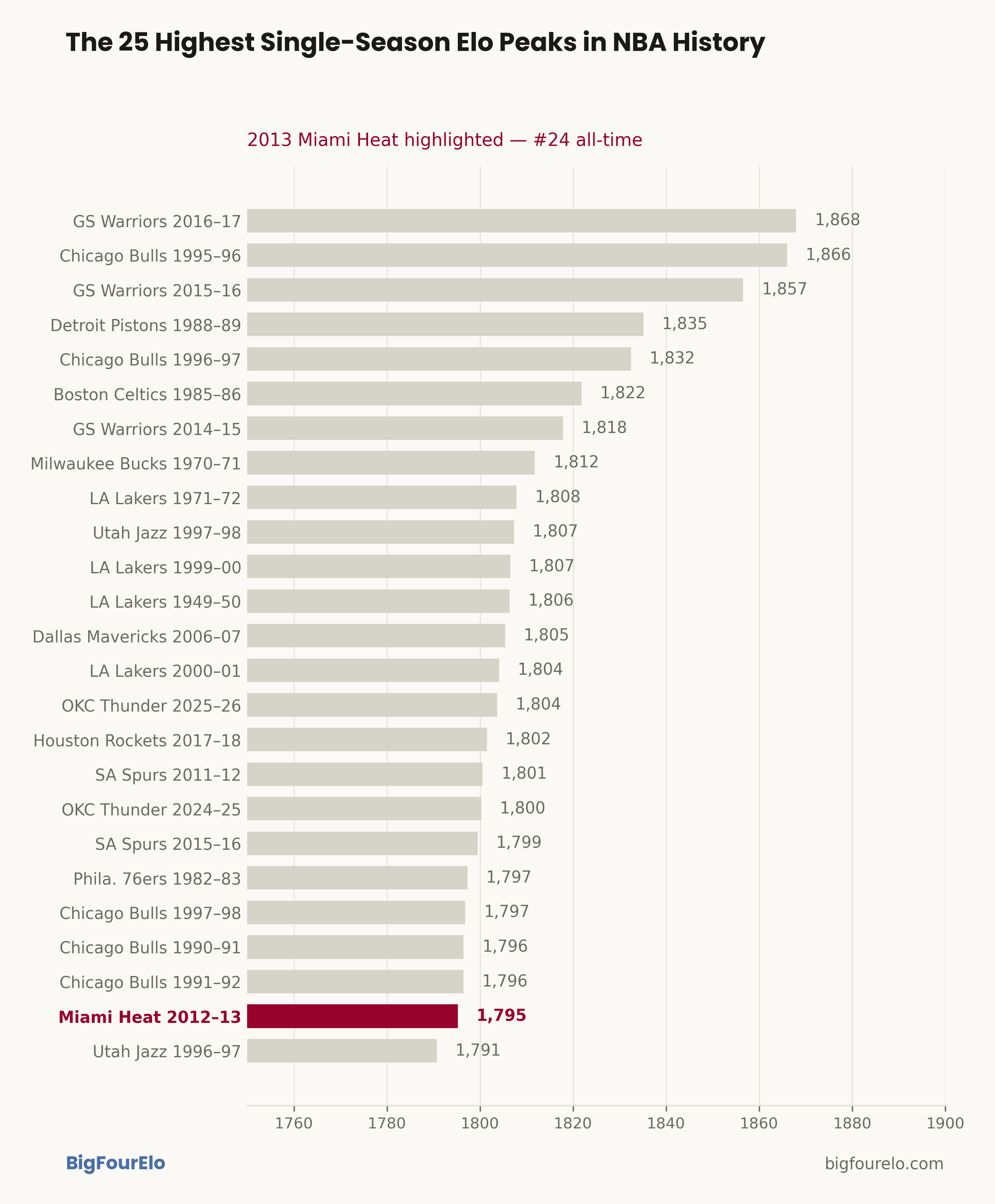
James and Chris Bosh signed matching six-year, roughly $110 million contracts that summer. Together with Wade, they formed arguably the most commercially powerful Big Three the league has ever seen. In the end, Miami delivered what was expected of it. After an unexpected Finals loss to the Dallas Mavericks in 2011, the Heat won back-to-back titles the next two seasons, beating the Oklahoma City Thunder in 2012 and the San Antonio Spurs in 2013—reaching an Elo of 1,795 on May 22, 2013, the highest mark in franchise history and the 24th-highest single-season peak in our entire database. It came just five seasons after Miami had touched its historic low of 1,220, in a stretch marked by Wade’s injuries and the fraying relationship between Shaquille O’Neal and seemingly everyone else in the organization before he was finally traded to Phoenix. That 1,795 mark was also a massive leap from the 1,553 rating Miami carried the moment LeBron announced, via The Decision, that he was taking his talents to South Beach.
The following season, the Spurs got their revenge, dismantling Miami in the 2014 Finals—and that’s where LeBron’s era in Florida ended. After four seasons, he exercised the opt-out in his contract and became a free agent on July 1, choosing to return to where it all started: his native Ohio, and Cleveland.
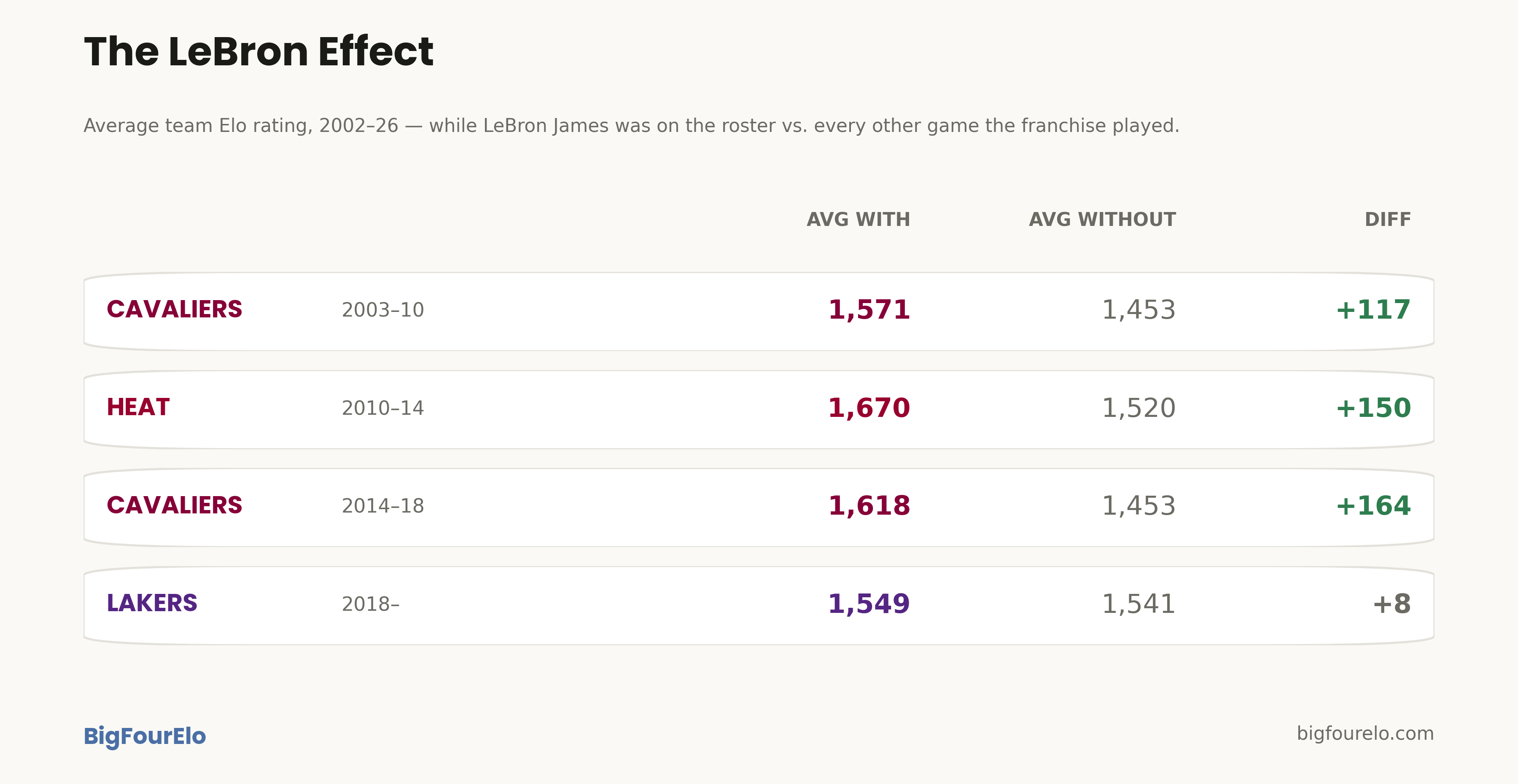
Cleveland had fallen apart in his absence. Across the next four seasons, the Cavaliers cleared a .400 win percentage only in the last of them, finishing 33–49 in 2013–14. Their average season-long Elo ratings over those four years were 1,375, 1,373, 1,353 and 1,392—an enormous drop from the 1,702 they’d averaged back in 2010.
In the meantime, though, Cleveland had won the lottery again, taking Kyrie Irving first overall in 2011. Kyrie developed into an All-Star, but unlike LeBron, he couldn’t carry a fairly thin roster by himself—so that summer of 2014, he got the best possible reinforcement imaginable. It’s worth noting Cleveland held three of the previous four No. 1 picks: Kyrie in 2011, Anthony Bennett in 2013 (who quickly proved to be a historic bust), and Andrew Wiggins in 2014, who was flipped to Minnesota in a trade for Kevin Love—a double-double machine who accepted a diminished role as Cleveland’s third scoring option in pursuit of a title as fast as possible.
The recap of LeBron’s second Cleveland stint is simple: four seasons, four Finals appearances, four consecutive series against the Golden State Warriors—a Warriors team that, at its Steph Curry-powered peak, reached an Elo of 1,868 on June 7, 2017, the highest figure we’ve ever recorded, two points clear of Michael Jordan’s 1995–96 Chicago Bulls. The Cavs came close to their own 2009 peak on two occasions but never surpassed it—though it’s a remarkable footnote that, having crossed 1,600 in March 2015, they didn’t fall back below it again for almost exactly two years.
LeBron’s second Cleveland stint was far shorter than his first, and in the summer of 2018, at 33, he moved on again—this time to arguably the league’s most famous franchise, the Los Angeles Lakers. The Lakers had been searching for a new leader since Kobe Bryant retired two seasons earlier. Their last title had come in 2010, and the decline accelerated in April 2013, when Kobe tore his Achilles. That December, the Lakers dropped below 1,500 Elo for the first time in years and stayed there for nearly five seasons.
James was seen as the way out, though he couldn’t get the Lakers into the playoffs in year one—his first missed postseason since 2005. In year two, everything clicked: the front office landed Anthony Davis in a blockbuster trade, and in the 2020 NBA bubble, LeBron delivered a title in his second season with a new club for the third time in his career.
The Lakers spent most of 2020 and 2021 above 1,600 Elo, touching 1,721 in early October 2020 before finishing that championship run at 1,718 on the night they clinched it. They haven’t reached that level since—not even with Luka Dončić, one of the best players in the game today, now also on the roster.
LeBron James is a free agent again this summer. He’s reportedly informed the Lakers he intends to play elsewhere next season, with his next destination still unknown. Even at 41, he averaged 20.9 points a game last season, and he’ll be a massive asset to whichever team lands him—on the floor and at the box office alike. He’s already played more games than anyone in NBA history, and he already holds the all-time scoring record. There’s nothing left for him to prove. All that’s left for the rest of us is to enjoy it, for as long as he keeps playing—whatever jersey he’s wearing.